September 2, 2026 • Celeste Marchand • 10 min reading time • Prices verified June 6, 2026
Raaka, Alter Eco, TCHO, and Beyond Good: Honest Verdicts on Craft Dark Bars That Lead With Ethics
There is a version of “ethical chocolate” that tastes like cardboard and guilt-tripping. These four brands are not that version — mostly. Raaka, Alter Eco, TCHO, and Beyond Good are among the most credible names in the fast-growing craft dark chocolate space, a category where makers commit to direct-trade sourcing (buying cacao directly from farmers at above-market prices), transparent supply chains, and sometimes organic or B-Corp certification. Those commitments matter. Smithsonian Magazine’s reporting on cacao supply chains — in their feature on the structural exploitation embedded in conventional chocolate production — makes clear that choosing brands who publish their sourcing isn’t a marketing quirk; it’s a meaningful purchasing decision. But ethics and flavor are not the same conversation. This piece is about both. You’ll come away knowing which bar belongs in whose hands, and which ones will disappoint a buyer who grabs them cold without understanding what they’re signing up for.
| EDITOR'S PICKRaaka Dark Chocolate Gift Box |… | Mid-tierRaaka Chocolate Best Sellers Tr… | Budget pickAlter Eco | Dark Chocolate Bars… | |
|---|---|---|---|
| Format | 30 mini pieces | 3 bars | 1 bar |
| Bar size | 0.28 oz each | 1.8 oz each | 2.82 oz |
| Total weight | 8.4 oz | 5.4 oz | 2.82 oz |
| Fair Trade | — | ✓ | ✓ |
| Flavor | Variety | Variety | Brown Butter |
| Price | $36.95 | $26.95 | $8.85 |
| See on Amazon → | See on Amazon → | See on Amazon → |
The Four Brands at a Glance
Before verdicts, a quick calibration on what each brand is actually doing differently.
Raaka is a Brooklyn maker whose defining characteristic is unroasted cacao. Most chocolate starts with roasted cacao beans; Raaka skips that step, calling their approach “virgin cacao.” The result is a flavor profile that leans fruity, bright, and sometimes almost wine-like — distinctly different from the warm, nutty depth of roasted-cacao bars. This is not a defect. It is a deliberate identity. The Chocolate Life’s coverage of unroasted versus roasted cacao processing explains that skipping roasting preserves volatile aromatic compounds responsible for higher-acidity fruit notes — the same reason Raaka’s bars polarize reviewers so cleanly.
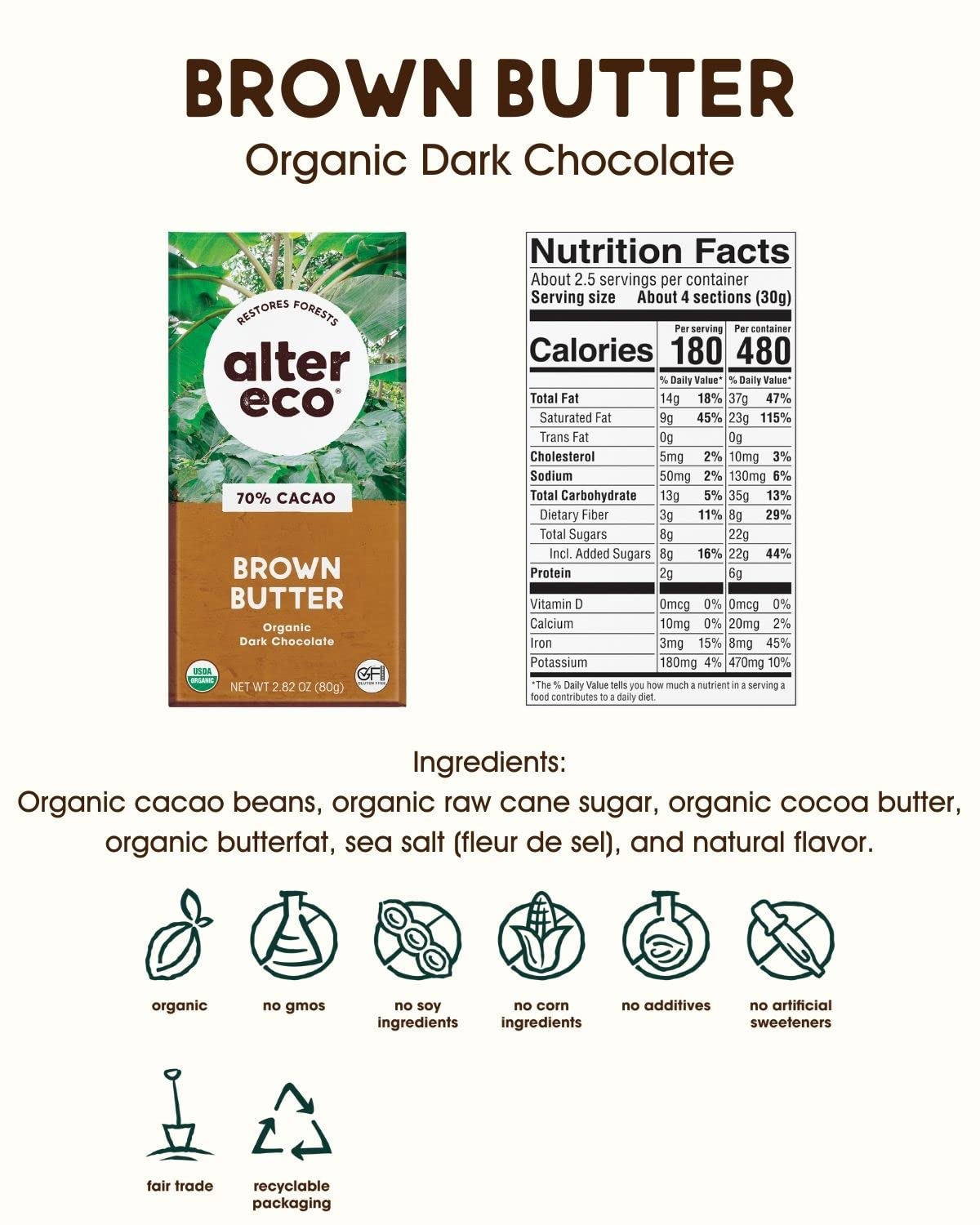
Alter Eco is a Swiss-founded, San Francisco-based brand built on certified organic cacao and a Fairtrade sourcing model. Their Brown Butter bar — salted, Swiss-style, with the cooked-butter depth the name promises — has become something of a cult object. It is approachable in a way the other brands on this list often are not.
TCHO (pronounced “cho”) is a San Francisco maker with a tech-company origin story, known for flavor-forward sourcing partnerships with cacao farms and, more practically for many buyers, bars with genuinely low sugar counts. Their bars skew toward chocolate professionals and low-carb buyers simultaneously, which is an unusual Venn diagram.
Beyond Good (formerly Madécasse) sources exclusively from Madagascar and Uganda, and their bars carry terroir-driven flavor intensity that can read as almost shocking to buyers used to commercial dark chocolate. Their Madagascar 70% is the best available demonstration of what “single-origin” actually means at the flavor level.
Honest Verdicts by Bar
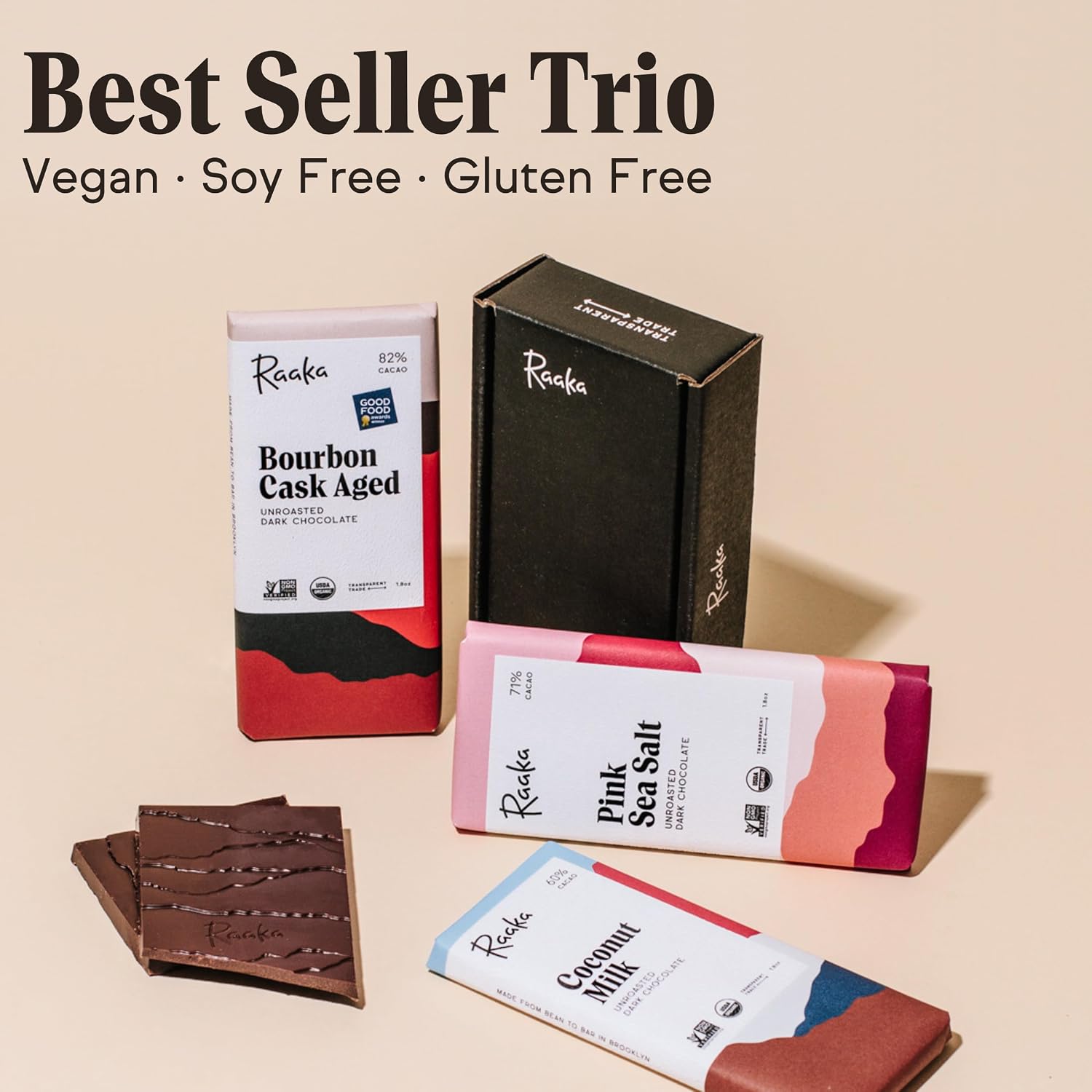
Raaka Best Sellers Trio
Who it’s for: Dairy-free buyers, adventurous chocolate eaters, people whose palate runs toward natural wine and funky ferments.
Who it’s not for: Anyone who expects dark chocolate to taste like dark chocolate as they already know it.
Raaka’s unroasted approach produces a bar that long-time dairy-free buyers frequently describe, in aggregated reviews, as the best dairy-free chocolate they’ve found after years of searching. That’s a meaningful endorsement in a category where dairy-free often means “waxy and vaguely chocolatey.” These bars are genuinely flavorful — but the flavor is intense, high-acidity fruitiness. Reviewers consistently flag notes that read like raisins or dried currants, and several explicitly say the profile is divisive: they either love it or don’t want to finish the bar.
That split is real, and it should factor into every gifting decision you make around this brand. For a dairy-free friend who is already a chocolate enthusiast, this trio is a genuine discovery. For a colleague who enjoys a Lindt 70% after dinner, Raaka’s flavor intensity may read as sour or overwhelming.
The 100% bar caveat: Raaka’s 100% cacao bar has generated pointed criticism from buyers approaching it as a keto-friendly ultra-dark bar, expecting something like an intensified Lindt 90% — bitter, clean, manageable. The reality is that unroasted 100% cacao tastes nothing like roasted 100% cacao. It is astringent in a different register, with raw cacao’s fermentation notes fully unmasked. This is not a quality failure; it is a fundamental misalignment of expectation and product. Do not gift or recommend this bar to anyone who hasn’t already navigated Raaka’s flavor profile at lower percentages.
Alter
$8.85
In stock on Amazon
Check price on AmazonAlter Eco Dark Brown Butter
Who it’s for: People who claim they don’t like dark chocolate but are open to being persuaded. Wellness-adjacent buyers. Fans of salted caramel who want something more sophisticated.
Who it’s not for: Purists looking for high-cacao-percentage intensity. Anyone wanting a vegan option — brown butter is dairy.
Bon Appétit’s roundup of ethical chocolate bars has recognized Alter Eco’s commitment to organic cacao and their Fairtrade sourcing model as genuine rather than performative, which tracks with what reviewers consistently report. But the Brown Butter bar earns its word-of-mouth on flavor, not certification. Reviewers who have found it locally unavailable and finally tracked it down describe it with “daily ritual” language — it’s the bar people return to because it is reliably satisfying rather than occasionally transcendent.
The organic cacao is real, carrying USDA certification, and the wellness framing some buyers apply isn’t entirely without foundation. Serious Eats’ analysis of cacao percentages and flavor notes that higher-cacao bars deliver more of the flavonoid compounds associated with cacao’s nutritional profile — though whether that matters to your specific buyer is a lifestyle question, not a chocolate question. The bar tastes good. That is the primary case for it.
Availability note: Alter Eco has expanded retail distribution meaningfully in recent years, but the Brown Butter bar’s placement in physical stores remains inconsistent by region. Online ordering is the reliable channel for guaranteed access.
Raaka
$26.95
In stock on Amazon
Check price on AmazonTCHO Dark Chocolate Bars
Who it’s for: Low-carb and keto buyers; people who want sophisticated dark chocolate that a non-chocolate-lover might actually enjoy.
Who it’s not for: Buyers seeking the most complex single-origin experience; those prioritizing the lowest price-per-gram.
TCHO’s bars carry a specific mechanical advantage in the low-carb segment: their sugar counts run notably lower than most comparable dark bars, which matters to any buyer with genuine dietary constraints. Across aggregated reviews, this point surfaces repeatedly and specifically — not as a vague “less sweet” observation, but as buyers comparing grams of sugar per serving and landing on TCHO as the number that fits their macros.
The flavor payoff is real alongside the nutritional profile. Bon Appétit’s coverage of craft chocolate sourcing has flagged TCHO’s direct farm partnerships as among the more transparent in the domestic segment. Reviewers include a notable data point: non-chocolate-lovers getting converted. One reviewer specifically credits a TCHO bar with turning a partner who had never wanted dark chocolate into a willing participant — a useful gifting signal that goes beyond the keto audience.
The keto question answered directly: TCHO runs low enough in sugar to fit most keto frameworks at moderate daily serving sizes, but “keto-friendly” is not a regulated claim. Check the current nutrition panel per serving before committing at volume for a dietary buyer whose thresholds are strict.
Raaka
$26.95
In stock on Amazon
Check price on AmazonBeyond Good Madagascar 70%
Who it’s for: Anyone curious about what single-origin actually tastes like. The buyer who has gotten bored with Lindt and wants to understand why people spend more on craft bars.
Who it’s not for: Buyers who find fruity wine notes in chocolate unsettling, or who want something sweet and smooth.
Beyond Good’s Madagascar sourcing produces what may be the most immediately legible demonstration of terroir available in this price tier — the same concept applied to wine, where a growing region shapes flavor in documentable, repeatable ways. Reviewers who approach this bar without expectation consistently report surprise at natural fruitiness so pronounced that, as one aggregated review puts it, the bar is hard to believe contains no red fruits or berries. No fruit flavoring is added. That is Madagascar cacao doing what Madagascar cacao does — a high-acid, berry-forward profile that the region’s volcanic soil and specific fermentation traditions produce reliably.
Smithsonian Magazine’s reporting on direct-trade sourcing is relevant context here: Beyond Good (formerly Madécasse) was among the early movers on sourcing and processing entirely within Madagascar and Uganda, creating economic value closer to origin rather than exporting raw beans for European processing. The flavor difference is real and documentable. The ethical structure is also real and documented. For buyers who want their purchasing to carry genuine supply-chain weight, this bar makes the case more concretely than most options in the craft segment.

Raaka
$36.95
In stock on Amazon
Check price on AmazonSide-by-Side Comparison
| Brand | Defining characteristic | Best buyer profile | Likely to disappoint |
|---|---|---|---|
| Raaka Best Sellers Trio | Unroasted, fruity-intense, dairy-free | Dairy-free enthusiasts, natural wine fans | Lindt and Ghirardelli loyalists |
| Alter Eco Brown Butter | Organic, salted, approachable | Skeptical dark-chocolate converts | Vegans, high-percentage purists |
| TCHO Dark Bars | Low sugar, transparent sourcing | Keto buyers, converting non-fans | Single-origin seekers |
| Beyond Good Madagascar 70% | Terroir-forward, genuinely fruity | Curious upgraders, origin explorers | Buyers who dislike tartness |
Frequently Asked Questions
Is Raaka chocolate actually good for people who are used to Lindt or Ghirardelli? Honest answer: probably not at first. Lindt and Ghirardelli use roasted cacao and produce the warm, rounded, slightly bitter flavor most people think of as dark chocolate. Raaka’s unroasted process creates something brighter, more acidic, and more fruit-forward. The adjustment is real. Buyers who cross over tend to be people who already enjoy natural wines, aged balsamic, or high-acidity fermented foods. If your reference point is Lindt Excellence 70%, start with Alter Eco or Beyond Good before trying Raaka.
What does unroasted cacao taste like compared to regular dark chocolate? Think of the difference between fresh fruit and dried, roasted nuts. Roasted cacao delivers depth, nuttiness, and bittersweet roundness. Unroasted cacao — Raaka’s method — delivers brightness, high-noted fruitiness, and sometimes a slight tartness that reads almost wine-like. Neither is objectively better; they are genuinely different products. The Chocolate Life’s coverage of this processing distinction, in their analysis of unroasted versus roasted cacao flavor development, is a useful deep-dive if you want the flavor chemistry explained in detail.
Is TCHO really low enough in sugar for keto? For most practical keto frameworks, yes — TCHO’s bars run lower in sugar per serving than most comparable dark bars and consistently satisfy buyers tracking macros. That said, individual keto thresholds vary, and serving-size discipline still matters. Verify the current nutrition panel before committing to a bulk order for a dietary-specific buyer.
Does Beyond Good actually taste fruity without adding fruit flavoring? Yes, and this is one of the more striking genuine terroir demonstrations available at a mid-range price. The fruitiness comes from Madagascar cacao’s inherent flavor profile — shaped by regional soil, fermentation practice, and processing — not from added flavoring. Reviewers who know nothing about single-origin sourcing report the berry notes as surprising and sometimes confusing. That is the point.
Which of these bars works as a gift for someone who doesn’t usually eat dark chocolate? Alter Eco Brown Butter is the clearest answer. The salted-butter richness softens the bitter edge that puts casual buyers off dark chocolate, and it is approachable without being dumbed down. TCHO is the second choice, particularly if the recipient has any low-carb interest. Raaka and Beyond Good are better gifts for people who already eat dark chocolate and want something genuinely new.
Is Alter Eco’s Brown Butter bar widely available in stores? Availability varies significantly by region. Specialty grocery and natural food retailers carry Alter Eco broadly, but the Brown Butter bar specifically has inconsistent physical-store placement outside major metro areas. Online ordering is the reliable option for guaranteed access.
The Decision Frame
If you’re buying for yourself and already eat dark chocolate regularly: Beyond Good Madagascar 70% is the clearest value proposition — genuine terroir, documented ethical sourcing, and a flavor surprise that recalibrates what “dark chocolate” can taste like.
If you’re buying dairy-free for someone who has already explored dark chocolate: Raaka’s Best Sellers Trio, with the explicit caveat that the profile is polarizing and the 100% bar is not a beginner move.
If you’re buying for a low-carb buyer or someone who thinks they don’t like dark chocolate: TCHO, no contest.
If you want the most gifting-safe ethical bar in this group: Alter Eco Brown Butter — it converts skeptics rather than challenging them.
Ethics and flavor don’t always travel together. With these four brands, they mostly do — as long as you match the bar to the buyer.