August 10, 2026 • Celeste Marchand • 10 min reading time • Prices verified June 6, 2026
Whitman's vs. Russell Stover vs. Lindt vs. Godiva: Which Classic Chocolate Box Actually Delivers
You already know what all four of these brands are, and that’s precisely the problem when you’re trying to choose between them. Whitman’s, Russell Stover, Lindt, and Godiva have been sitting on drugstore shelves and holiday wishlists for decades — long enough that most buyers treat them as interchangeable. They are not. Each one occupies a distinct niche in terms of chocolate quality, piece count, shipping reliability, and what the name signals to the person opening the box. “Classic chocolate box” — meaning a pre-curated assortment sold as a gift, not a build-your-own artisan collection — is a broad category, and buying wrong for a given occasion is an easy mistake to make. This piece breaks down each brand on the dimensions that actually matter: flavor, value, logistics, and gifting optics. It ends with a clear decision framework and a set of tier-based picks for matching the right box to your exact situation.
The Four Brands at a Glance: What You’re Actually Buying
Before the per-piece math and shipping logistics, it helps to understand the house style of each brand — what their chocolate is trying to do and who it’s trying to serve.
Whitman’s Sampler
Whitman's
$13.99
In stock on Amazon
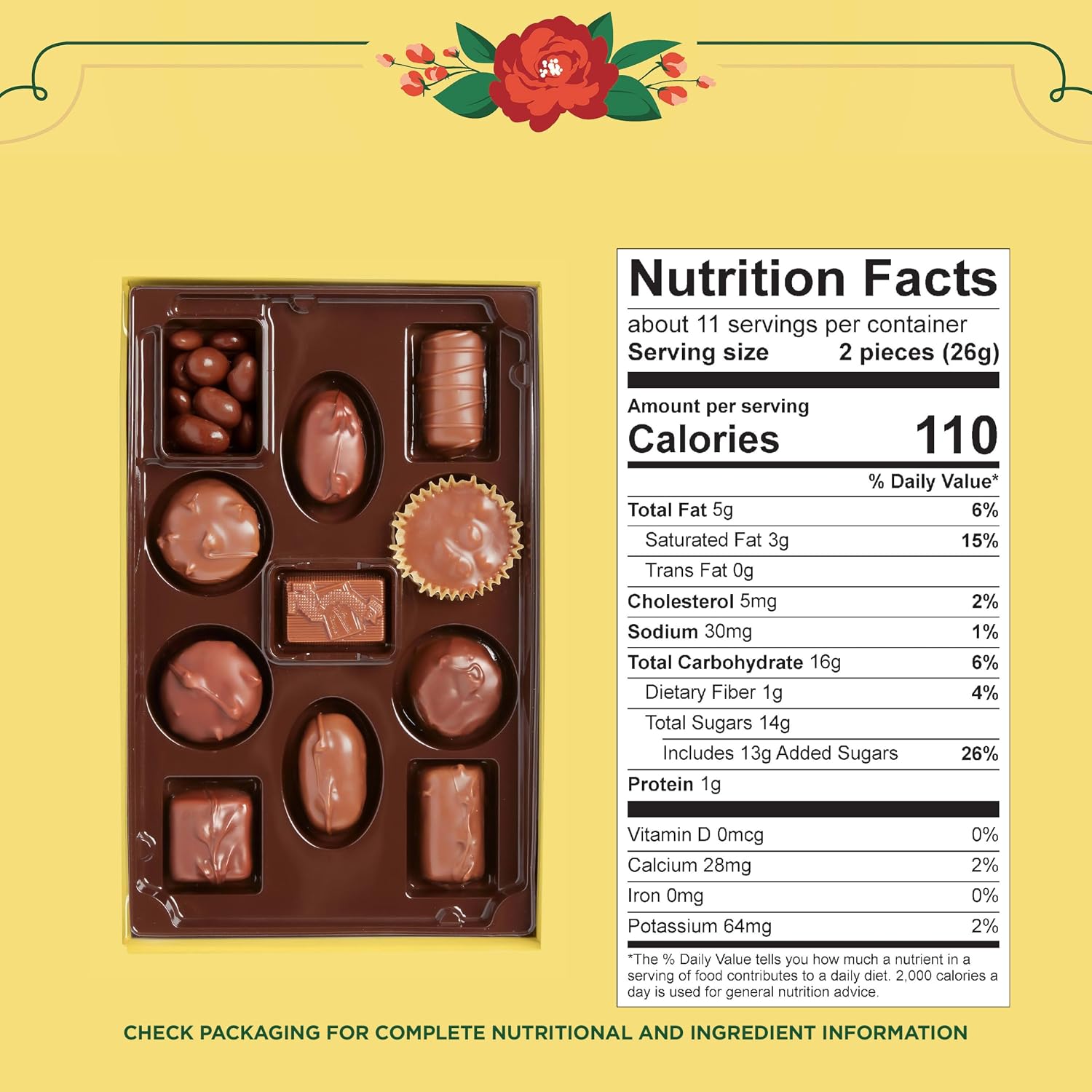
Check price on AmazonWhitman’s is the original American assortment box, with roots dating to 1842 — a lineage noted in Smithsonian Magazine’s coverage of American confectionery history. The appeal is predictability: a wide variety of centers (nut clusters, creams, caramels, cordials) wrapped in a familiar yellow box that reads as warm and nostalgic rather than luxurious. The chocolate coating is milk-chocolate-forward and sweet rather than complex. Buyer feedback across retailer platforms consistently describes it as a “reliable” gift for neighbors, coworkers, and older relatives who grew up with the brand. The piece count is generous for the price, and the variety is broad enough that nearly every recipient finds something they like.
Best for: Volume gifting, warm-weather shipping, budget-conscious holiday rounds, and recipients who associate the brand with happy memory rather than prestige.
Tier verdict: Budget pick — high piece count, low per-piece cost, resilient enough for standard shipping.
Whitman's
$13.99
In stock on Amazon
Check price on AmazonRussell Stover
Whitman's
$13.99
In stock on Amazon
Check price on AmazonRussell Stover positions similarly to Whitman’s in price and retail footprint, but the assortment leans harder into soft-center pieces — caramels, maple creams, and coconut — rather than the nut-heavy variety Whitman’s offers. Epicurious, in its coverage of boxed chocolates for gifting, notes that soft-center assortments skew toward a distinctly American palate that prizes yielding texture and moderate sweetness. Russell Stover delivers exactly that. Buyer consensus singles out the caramels and maple cream pieces as standout items; the enthusiasm attached to those specific pieces suggests a flavor profile that genuinely over-delivers at its price point.
Russell Stover is a lateral move from Whitman’s, not a step up or down. It’s a different flavor emphasis — soft and sweet — serving the same price tier.
Best for: Recipients who favor caramels and soft centers over nuts and clusters, holiday gifting at volume, and warm-weather shipping where sturdier chocolate is an advantage.
Tier verdict: Budget pick — strong soft-center variety, similar logistics resilience to Whitman’s.
Whitman's
$13.99
In stock on Amazon
Check price on AmazonLindt LINDOR

Lindt
$29.99
In stock on Amazon
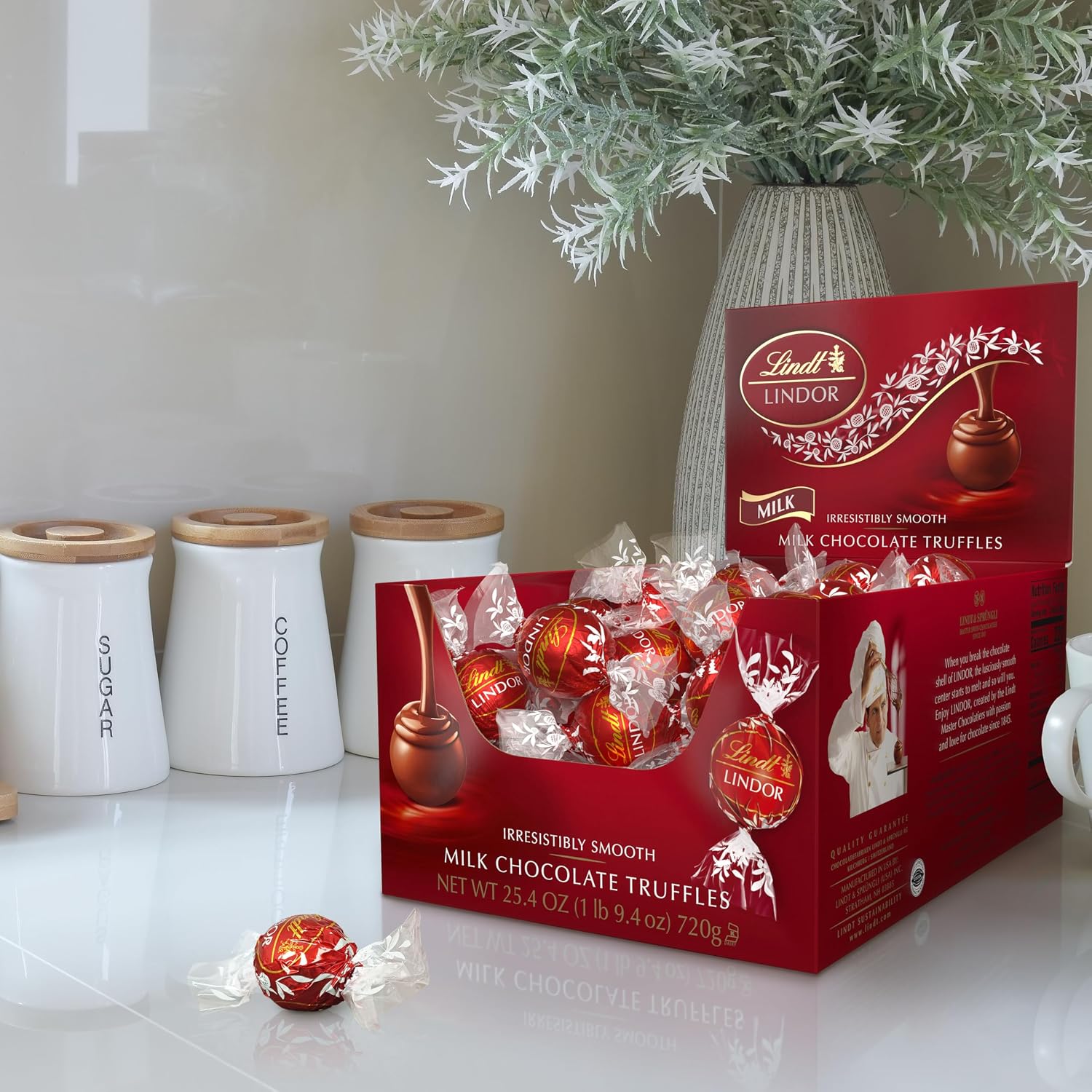
Check price on AmazonLindt LINDOR is a different product category in the same gift-box format. LINDOR truffles are ganache-filled — ganache being a smooth blend of chocolate and cream — round confections with a thin shell and an unusually soft, melting center. Lindt is a Swiss confectionery company with over 175 years of history, and LINDOR specifically is engineered for one sensation: a silky, slow melt that generates consistently enthusiastic responses from recipients who encounter it for the first time.
Serious Eats, in its framework for evaluating boxed chocolate, identifies mouthfeel and center-to-shell ratio as two of the most important markers of quality in an assorted box. On both counts, LINDOR’s ganache construction performs well — when it arrives intact.
That caveat is significant. Buyer feedback across multiple retail channels documents a recurring pattern: in warm months (roughly May through September across most of the US), LINDOR truffles shipped in the brand’s standard lightweight paper envelope packaging arrive melted, fused, or deformed. This is not an edge case. The same property that makes LINDOR’s center so appealing — its ultra-soft ganache — makes it acutely vulnerable to heat. If you’re ordering for summer delivery and cannot ensure fast, shaded arrival and immediate retrieval, melt risk is a genuine, documented product hazard.
Best for: Cool-season gifting, hand delivery, local pickup, and recipients who appreciate texture sophistication and a cleaner European brand presentation over variety-assortment breadth.
Tier verdict: Mid-tier pick — best eating experience in its price range when logistics cooperate; melt risk limits warm-weather utility.
Lindt
$29.99
In stock on Amazon
Check price on AmazonGodiva
Lindt
$34.99
In stock on Amazon
Check price on AmazonGodiva is the prestige-positioning play in this group. Established in Belgium in 1926 and now widely distributed in the US, Godiva occupies the brand-name sweet spot where the box itself does gifting work before a single piece is eaten. Wirecutter’s guidance on gift chocolate buying emphasizes that packaging and brand recognition perform measurable social work at the moment of presentation — particularly in professional and formal contexts. Godiva is the clearest illustration of that principle among widely available chocolate gifts.
The gold box, the Belgian heritage positioning, and broad consumer name recognition mean a Godiva delivery reads as a deliberate, generous choice. In a professional or formal context — a client thank-you, a milestone occasion, a gift delivered to someone’s office — Godiva carries a signal that Whitman’s and Russell Stover simply do not. Buyer feedback confirms this dynamic explicitly: recipients in professional settings notice and respond to the Godiva name in ways they do not with lower-tier assortment brands.
On the logistics side, Godiva is also meaningfully better than Lindt for warm-weather online orders. Verified buyer reports across multiple Godiva gift box formats confirm that Godiva includes cold-chain packaging (ice packs and insulated liners) for warm-weather shipments. This is not guaranteed across every format and every shipping window, so confirmation at order time is worthwhile — but the pattern in buyer reports is consistently favorable and stands in direct contrast to Lindt’s uninsulated envelope approach.
Best for: Corporate gifting, formal occasions, first-impression gifts, professional contexts where the name does visible work, and warm-weather online delivery where cold-chain packaging matters.
Tier verdict: Premium pick — highest per-piece cost, highest brand equity, best logistics infrastructure for year-round online gifting.
Lindt
$34.99
In stock on Amazon
Check price on AmazonBy the Numbers: Piece Count and Price Per Piece
Exact retail pricing shifts with promotions and seasonality, but the structural math across these four brands is stable enough to reason from. Epicurious and Serious Eats both note that per-piece cost is a more useful unit of comparison than total box price, since box sizes vary widely across and within brands.
| Brand | Typical Piece Count | Price Tier | Approx. Price Per Piece |
|---|---|---|---|
| Whitman’s Sampler | 24–36 pieces | $ | $0.40–$0.65 |
| Russell Stover | 18–36 pieces | $ | $0.45–$0.75 |
| Lindt LINDOR | 21–60 pieces | $–$$ | $0.55–$1.10 |
| Godiva | 12–36 pieces | $$–$$$ | $1.50–$3.50+ |
The Godiva price-per-piece premium is real and significant — roughly three to five times the per-piece cost of Whitman’s or Russell Stover at comparable box sizes. Whether that premium is justified depends entirely on the occasion and what you need the gift to communicate, which the decision framework below addresses directly.
Shipping and Logistics: The Hidden Differentiator
For anyone buying online — which is now the majority of gift chocolate buyers — chocolate logistics matter more than most purchasers realize until they get burned once.
Serious Eats’ coverage of mail-order chocolate identifies temperature-controlled shipping as the single most underrated variable in online chocolate gifting. That observation maps precisely onto the documented differences among these four brands.
Lindt LINDOR’s melt problem is real and recurring. The consistent pattern in buyer reports is that in warm months, LINDOR truffles shipped in lightweight paper envelopes arrive compromised at a rate that represents a genuine product risk — not an occasional mishap. The irony is structural: LINDOR’s signature feature is its ultra-soft ganache center, the same property that makes it uniquely vulnerable to heat. Ordering LINDOR for summer delivery without being able to control arrival conditions and retrieval timing is accepting meaningful, documented risk.
Godiva’s cold-chain packaging is a documented advantage. Buyer reports across multiple Godiva gift formats confirm that Godiva includes ice packs and insulated packaging for warm-weather orders. Confirm this at order time, but the pattern is favorable and consistent.
Whitman’s and Russell Stover use harder-tempered chocolate formulations than a ganache truffle, making them meaningfully more resilient to shipping heat. They are not immune to melt — no chocolate is — but the threshold is higher, and the failure mode (slightly soft clusters or creams) is less severe than the complete fusion that can happen to LINDOR truffles in a hot delivery truck.
Decision Framework: Matching Box to Occasion
If you need warm-weather online delivery and can’t control timing: Rule out Lindt LINDOR. Godiva (with confirmed cold-chain packaging) or the sturdier chocolate formulations of Whitman’s or Russell Stover are the lower-risk choices.
If gifting credibility matters — corporate, professional, or formal occasions: Godiva is the correct answer. The price premium is doing real social work. As Wirecutter’s gift guidance notes, brand recognition in chocolate gifting functions as a proxy for care and investment in contexts where the recipient doesn’t know your budget but does know the name on the box.
If budget is the primary constraint and you need volume: Whitman’s Sampler. The per-piece math is favorable, the variety is broad, the freshness record is strong, and the brand reads as warm rather than cheap. It is a legitimate choice for holiday rounds, coworker gifts, and neighbor sends.
If your recipient specifically favors caramels and soft-center pieces: Russell Stover. The caramel and maple cream pieces are the brand’s consensus standout items, and that specific flavor profile — sweet, yielding, soft-center-forward — is worth matching to the right recipient rather than defaulting to Whitman’s nut-forward variety.
If the eating experience is the priority and logistics aren’t a concern: Lindt LINDOR. Serious Eats’ framework for boxed chocolate — balance, mouthfeel, center-to-shell ratio — favors LINDOR’s ganache construction when temperature is not a variable. Hand-delivered, locally picked up, or shipped in cool months, it is the most texturally sophisticated option in this group at its price point.
If it’s a last-minute thank-you gift: Whitman’s or Russell Stover. Both ship reliably, tolerate temperature variation better than LINDOR, and arrive in gifting-ready packaging without the delivery anxiety that comes with a ganache-heavy truffle box in warm weather.
Frequently Asked Questions
Does Lindt LINDOR actually arrive melted in summer? Yes, this is a documented and recurring problem. Buyer reports across multiple purchase cycles confirm melted, fused, or deformed truffles when ordering LINDOR in warm weather. The lightweight paper envelope packaging provides no thermal buffer. Between May and September, if you cannot ensure fast delivery and immediate retrieval, this is a real risk worth planning around.
Is Whitman’s Sampler good enough to give as a gift, or does it feel cheap? It is absolutely gift-appropriate, with one caveat: it reads as warm and familiar, not luxurious. For coworkers, neighbors, holiday rounds, and “thinking of you” sends, Whitman’s lands well. For formal or first-impression gifting, it does not carry sufficient prestige signaling.
How many pieces does each box contain and what is the price per piece? Standard configurations: Whitman’s runs 24–36 pieces at roughly $0.40–$0.65 per piece; Russell Stover 18–36 pieces at $0.45–$0.75; Lindt LINDOR 21–60 pieces at $0.55–$1.10; Godiva 12–36 pieces at $1.50–$3.50 or more depending on format. Godiva’s per-piece cost is meaningfully higher, which is appropriate when brand presentation is a core part of the gift.
Does Godiva really ship with ice packs? Per buyer feedback across multiple Godiva gift box formats, yes — Godiva includes cold-chain packaging for warm-weather orders. This is a real and documented differentiator relative to Lindt’s uninsulated approach. Confirm at order time, as not every configuration and shipping window is covered, but the pattern in buyer reports is consistently favorable.
Is Russell Stover a step up or step down from Lindt? Neither — it’s a step sideways. Russell Stover and Whitman’s compete in the same value-assortment tier; Lindt LINDOR is a different product (a ganache truffle) at a slightly higher price point with a different flavor profile entirely. Russell Stover’s advantage over Lindt is shipping resilience and soft-center variety; Lindt’s advantage is texture sophistication and cleaner brand presentation. Neither is categorically better; they serve different recipient preferences and different logistics conditions.